
A number of important exhibitions that opened earlier during the year, and are still being featured across the country, are accessible from the BAP Blog page entitled: Select Art Exhibitions in 2015. That page is updated on a weekly basis by either adding newly discovered exhibitions or removing those that are approaching their expiration date. Its intent is to provide comprehensive coverage of current ongoing exhibitions on view for the current year.
Black Art Project (BAP) welcomes any information or leads that you might have relating to Black art exhibitions, particularly regional exhibitions that are not traditionally marketed on a national scale. BAP will verify the accuracy of any information submitted. Thank you for any assistance that you provide.
Ann Arbor, Michigan
University of Michigan Museum of Art (UMMA)
The Art of Tyree Guyton: A Thirty-Year Journey
 | |
| Tyree Guyton, The New White House, a.k.a., the Dotty Wotty House, 2010. Heidelberg Project Archives |
The Heidelberg Project has been the life's work of artist Tyree Guyton. He grew up on Heidelberg Street, and was encouraged by his house painter grandfather to choose art as an alternative to drugs and guns. Guyton began the project with his family, and with help of
 |
| Tyree Guyton, House of Soul, 2012-2013 (destroyed by fire in November 2013), Heidelberg Project Archives |
The 30-year anniversary of the Heidelberg Project is a moment for Guyton, and his audience, to reflect on what his work has meant to the cultural life of Detroit and beyond. Guyton has created two new works specifically for this exhibition, one in the studio and one in the project. How Much for the City, a mixed-media sculpture, makes reference to his long-standing struggles with city government. On Heidelberg Street, he is building a full-scale house; it will rise on the foundation of a house destroyed by arson. The process of its construction can be viewed on the Heidelberg Television monitor in the gallery.
The Art of Tyree Guyton explores the artist's involvement with the project through the decades, and also feature a selection of prints and drawings from his more recent studio work.
Lead support for this exhibition is provided by the Michigan Council for Arts and Cultural Affairs and the National Endowment for the Arts, the Andy Warhol Foundation for the Visual Arts, and Lisa Applebaum. Additional generous support is provided by the University of Michigan Taubman College of Architecture and Urban Planning and School of Social Work.
Programs:
Friday, September 25, 2015, 5:30 - 7:30 PM
Sunday, November 08, 2015, 3 - 4 PM
Saturday, November 14, 2015, 11 AM - 1 PM
Atlanta, Georgia
Spelman College Museum of Fine Art
Howardena Pindell

VIDEO: Courtesy of the artist and Garth Greenan Gallery, New York.
Howardena Pindell
| Howardena Pindell, Free, White and 21, 1980. Color video with sound, | 12:15 minutes. |
Spelman College Museum of Fine Art presents Howardena Pindell, a solo exhibition of the artist's intricately layered mixed-media paintings and works on paper. The exhibition, which will be on view through December 5, 2015, spotlights Pindell's dynamic works from 1974-1986 and explore how she blends her abstract formal sensibilities, personal memory and activism through the lens of life history.
Pindell is known for her oblong and unstretched canvases that are often
torn apart and stitched back together. Her detailed experimentation with hole-punched circles, hand-written numeration and personal postcards create atmospheric work that considers the relationship between chaos and logic, time and repetition, and force and movement. As a result, the painstaking compositions of her paintings reimagine the medium and its process. This exhibition celebrates a creative risk-taker, a seasoned traveler and an advocate for equality.
Pindell is known for her oblong and unstretched canvases that are often
torn apart and stitched back together. Her detailed experimentation with hole-punched circles, hand-written numeration and personal postcards create atmospheric work that considers the relationship between chaos and logic, time and repetition, and force and movement. As a result, the painstaking compositions of her paintings reimagine the medium and its process. This exhibition celebrates a creative risk-taker, a seasoned traveler and an advocate for equality.
An influential figure in the art world for over 40 years, Pindell has remained committed to expanding opportunities for women artists of color. She has been fiercely devoted to life and career, art, activism and advocacy. In the foreword to The Heart of the Question: The Writings of Howardena Pindell, she said, "I sustain myself through sheer tenacity, as the art world does not want artists of color to be full participants. I work because it's my life's work. I have no other choice."
Programs:
Thursday, September 24, 2015, 6:30 PM
An Evening with Howardena Pindell and Dr. Mary Schmidt Campbell
This is a landmark conversation between two pioneering creative public intellectuals on visual art and the art world, autobiography and the creative process.
Saturday, September 26, 2015, 1 - 4 PM
Community Day
A fun-filled exploration of Howardena Pindell for participants of all ages that includes make-and-take workshops, interactive tours, giveaways from local cultural institutions and more.
Wednesday, September 30, 2015, 6:30 PM
Conversation with the Curators
Further Reading:
Howardena Pindell Exhibition Brochure
Chicago, Illinois
Hyde Park Art Center
Jefferson Pinder: Onyx Odyssey
 |
| Jefferson Pinder, Assimilated, Neon, 2009 |
Jefferson Pinder: Onyx Odyssey will be on view at the Hyde Park Art Center from November 1, 2015 through January 24, 2016. The exhibition, Onyx Odyssey, may be viewed in Gallery 1 and the Jackman Goldwasser Catwalk Gallery.
Interdisciplinary artist Jefferson Pinder will present a series of new
work in video and sculpture that extend his study in the tropes of black identity. Navigating the various definitions of the black male figure, from Ben Hur to W.E.B. DuBois to most recently, Michael Brown in Ferguson, Missouri, Pinder asks what psychological or physical substance unites or determines the strength of a race. Inspired by soundtracks, Pinder also utilizes hypnotic popular music and surreal performances to underscore themes dealing with Afro-Futurism, physical endurance and blackness.
Pinder is currently an Associate Professor in the Contemporary Practices Department at the School of the Art Institute of Chicago. His work has been featured in numerous group shows including exhibitions at The Studio Museum in Harlem, the Wadsworth Athenaeum Museum of Art in Hartford, Connecticut, The High Museum in Atlanta, the Corcoran Gallery of Art, and the Zacheta National Gallery in Warsaw, Poland.
Clinton, New York
Ruth and Elmer Wellin Museum of Art, Hamilton College
Karen Hampton: The Journey North
NOTE: Renée Stout: Tales of the Conjure Woman is also on view at the Wellin Museum of Art, October 03 through December 20, 2015.
Tales of the Conjure Woman is a collaborative project between the Halsey Institute of Contemporary Art at the College of Charleston, Spelman College Museum of Fine Arts in Atlanta, and the Ruth and Elmer Wellin Museum of Art.
Los Angeles, California
Hard Edged: Geometrical Abstraction and Beyond explores the evolving practice of geometrical abstraction in contemporary art. illustrating the rich interplay of tradition, innovation, and individual talent among forty-six visual artists of African descent. The exhibition, which will be on view at CAAM through April 24, 2016, offers an expansive and exploratory appreciation of geometrical abstraction not only in painting, but also in assemblage, installation, photography, video, quilting, and mixed-media works. Features common to many works include the prominent use of lines and sharply edged shapes, a sense of composition, unity of form, intense contrasts, and flat fields of color.
The approaches of the artists in Hard Edged are very different, from perceptual to conceptual, from formal to boundary crossing. Some are minimalistic while others celebrate color and texture exuberantly. Although working at various levels of abstraction, the artists in this exhibition address such important issues as feminism, identity, colonialism, stereotypes, family relations, and social justice.
Hard Edged: Geometrical Abstraction and Beyond draws widely from local sources, including CAAM's permanent collection, private collectors, galleries, and the artists themselves, and it includes Chelle Barbour, Sharon Louise Barnes, April Bey, Joseph Beckles, Ronda Brown, Mark Broyard, Lavialle Campbell, Elizabeth Catlett, Castillo, Edward Clark, Charles Dickson, June Edmonds, Melvin Edwards, Kathie Foley-Meyer, Bre Gipson, David Hammons, Hillary Jaynes, Daniel LaRue Johnson, Rashid Johnson, Samuel Levi Jones, Doyle Lane, Jacob Lawrence, Isabelle Lutterodt, Enoch Mack, Eric Mack, Senga Nengudi, Nzuji de Magalhães, Kori Newkirk, Duane Paul, Doug Pearsall, Karl J-G Petion, Greg Pitts, Noah Purifoy, Charla Puryear, Miles Regis, John T. Riddle Jr., Michelle Robinson, Charles Rosenberg, Lisa C Soto, Devin Troy Strother, Holly Tempo, Matthew Thomas, Richard Turner, Tim Washington, Lisa Diane Wedgeworth, and Brenna Youngblood.
Programs:
Saturday, September 26, 2015, 1-3 PM
Sculpture-making Workshop with Charla Puryear. Participants create their own glass and wire-hanging artworks.
Saturday, October 17, 2015, 1-3 PM
Marble Tagging Workshop with April Bey. Write your own messages on marbled paper that you will create with the Suminagashi technique of water printing/paper marbling.
Saturday, November 21, 2015, 1-3 PM
Yarn-Painting Workshop with Nzuji de Magalhães.
Saturday, January 30, 2016, 1-3 PM
Abstraction Today: A Conversation. Several of the artists featured in Hard Edged discuss their work with curator Mar Hollingsworth.
New York, New York
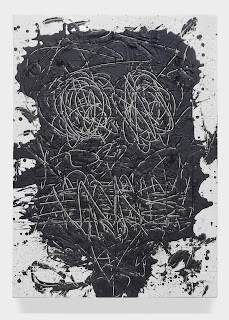
The Drawing Center will present Rashid Johnson: Anxious Men, a site-specific installation created by Johnson for the Drawing Room gallery. Anxious Men will be on view October 2 through December 20, 2015. The core of the exhibition is a new series of black-soap-and-wax-on-tile portraits that Johnson calls his anxious men. Executed by digging into a waxy surface, they enact a kind of drawing through erasure and represent the first time Johnson has worked figuratively outside of photography or film, and on such a small scale. Whereas Johnson's previous work has taken a more cerebral approach to questions of race and political identity, the drawn portraits confront
the viewer with a visceral immediacy.
The portraits will be set within a multi-sensory environment that
includes wallpaper depicting a photograph of the artist's father from the year Johnson was born, and an audio sound track comprised of Melvin Van Peebles' Love, That's America, a song originally featured in Peebles' 1970 film Watermelon Man and that was recently pressed into service by the Occupy Wall Street movement. In this way, the exhibition will create an immersive space that implicates not only the artist, but also the viewer in its interrogation of self-hood and identity.
Johnson's work is wide-ranging and has been discussed within the context of contemporary painting, photography, sculpture, video, installation, and even performance. Now, with Anxious Men, drawing enters the list.
An edition of the Drawing Papers series will be published in conjunction with this exhibition.
Lead support for Rashid Johnson: Anxious Men is provided by Joseph G. Mizzi. Additional support is provided by Jeffrey A. Hirsch, John and Amy Phelan, Erica Samuels, and Melva Bucksbaum and Raymond Learsy. Special thanks to Hauser and Wirth.
Program:
Thursday, October 15, 2015, 6:30 PM
Join the artist and Claire Gilman, Senior Curator at the Drawing Center and curator of Rashid Johnson: Anxious Men, for a walk through of the exhibition.
Philadelphia, Pennsylvania
The procession in the exhibition's title highlights a prominent thread that runs through much of Lewis' work: the procession ritual. Procession could be both celebratory and terrifying for Lewis, equally carrying allusions to carnevale and Ku Klux Klan marches. Such duality was at the heart of his artistic practice which employed representation and abstraction; geometric and organic forms; somber calligraphic markings and brilliant fields of color.
Procession: The Art of Norman Lewis will consider the complexity of Lewis' art by examining the role of figuration within Abstraction Expressionism and how Lewis subtly referenced social issues within an essentially abstract mode. The exhibition also will highlight the richly expressive palette the artist championed throughout his career.
Procession: The Art of Norman Lewis will be accompanied by a fully illustrated catalogue.
The major exhibition sponsors are the National Endowment for the Arts and Christie’s. Additional support from AG Foundation, L. Ann and Jonathan P. Binstock, Ed Bradley Family Foundation, Jacqueline Bradley and Clarence Otis Jr., Dr. Aliya and Reginald Browne, Valentino D. Carlotti, Christina Lewis Halpern and Loida Nicolas Lewis, Charles and Kathy Harper, Robert Horwitz and Catherine Redlich, Dorothy Lichtenstein, The Lomax Family Foundation, Winston and Carolyn Lowe, Raymond J. McGuire and Crystal McCrary, Frank and Katherine Martucci, Michael Rosenfeld Gallery, New York, Laurie M. Tisch Illumination Fund, and the Terra Foundation for American Art on behalf of board members Ruth Fine and Charles Harper.
Programs:
Saturday, November 14, 2015, 11:00 AM
Friends and Family Brunch: Join PAFA with a special friends and family brunch as a part of opening weekend celebration for Procession: The Art of Norman Lewis.
Sunday, November 15, 2015, 11:30 AM - 1:30 PM
Trolley Tour: Join PAFA as they partner with the Mural Arts Program for a unique and moving museum and tour experience. Take a Mural arts trolley tour of the Albert M. Greenfield African American Iconic Images Collection, then view Procession: The Art of Norman Lewis.
Saturday, December 5, 2015, 11 AM - 3 PM
Observe and Create:The Abstract Ideal: After viewing and exploring Lewis' artworks, participants will have an opportunity to create their
own work of art.
Traveling Lecture Series:
The Traveling Lecture Series, offered in conjunction with ongoing exhibitions, brings museum staff members out to your institution to give a talk about an artist or art movement important to our mission. This program is free to the public.
To view an even wider inclusion of exhibitions across the country: SEE
Exhibitions 2015.
Interdisciplinary artist Jefferson Pinder will present a series of new
 |
| Jefferson Pinder, Overture, HD video, 2013 |
Pinder is currently an Associate Professor in the Contemporary Practices Department at the School of the Art Institute of Chicago. His work has been featured in numerous group shows including exhibitions at The Studio Museum in Harlem, the Wadsworth Athenaeum Museum of Art in Hartford, Connecticut, The High Museum in Atlanta, the Corcoran Gallery of Art, and the Zacheta National Gallery in Warsaw, Poland.
Clinton, New York
Ruth and Elmer Wellin Museum of Art, Hamilton College
Karen Hampton: The Journey North
 |
| Karen Hampton, Spirits Cry, 2000
Image transfer on hand-woven linen, Amoco non-woven
geotextile thread,
and indigo dye, 36¼" × 49 3/8"
Courtesy of the artist
|
The Wellin Museum of Art presents Karen Hampton: The Journey North; the exhibition will be on view October 3 through December 20, 2015. The Journey North features new and recent textile works that tie together stories of Hampton's multicultural heritage, from her family's colonial past to her present experiences as a person of African, Caribbean, and American descent. Los Angeles-based textile artist Karen Hampton applies a contemporary approach to examining the African-American diaspora in this exhibition that explores her personal and ancestral narrative.
The Journey North is a multi-layered installation that showcases the aesthetic and conceptual richness of Hampton's textile works, which are interwoven with a myriad of genealogical references, and serve as a personal vehicle for instilling the experiences of those who came before her while charting and claiming Hampton's own unique place within that history.
Karen Hampton: The Journey North is organized around several narrative threads that, when woven together, culminate in a complex tapestry of Hampton's hopes and visions for African-American lives. A self-described griot, Hampton uses cloth as her medium to embed references to her genealogical discoveries through stitching, weaving, and digitally printing layered images, inscription of voices, and other historical markers. Employing embroidery and weaving, Hampton follows in the footsteps of African-American women quilters as she hand-stitches her family roots to illustrate their "journey north." She also incorporates modern techniques that include archival photo transfers and painting to embellish and invent a new style of narrative.
Karen Hampton: The Journey North is curated by Steven J. Goldberg, Associate Professor of Art History, Hamilton College, and Susanna White, Associate Director and Senior Curator of Collections, Wellin Museum of Art. The exhibition catalogue features essays by Steven J. Goldberg and independent curator, scholar and art critic Gylbert Coker, Ph.D.
Karen Hampton: The Journey North is organized around several narrative threads that, when woven together, culminate in a complex tapestry of Hampton's hopes and visions for African-American lives. A self-described griot, Hampton uses cloth as her medium to embed references to her genealogical discoveries through stitching, weaving, and digitally printing layered images, inscription of voices, and other historical markers. Employing embroidery and weaving, Hampton follows in the footsteps of African-American women quilters as she hand-stitches her family roots to illustrate their "journey north." She also incorporates modern techniques that include archival photo transfers and painting to embellish and invent a new style of narrative.
The exhibition follows Hampton's maternal and paternal lineage, tracing her family's history from Florida, a slave plantation in Maryland, and the Caribbean, to the artist's own story. The Journey North spans her family's encounters with such historical events as English and Spanish settlement in the 1700s, plantation life in the antebellum South, and the Civil War. As Hampton narrates the internal struggles that accompanied her ancestors' diaspora, she grapples with the mythology of freedom in America and examines the conflicting ideals inherent to our nation's founding documents.
Karen Hampton: The Journey North is curated by Steven J. Goldberg, Associate Professor of Art History, Hamilton College, and Susanna White, Associate Director and Senior Curator of Collections, Wellin Museum of Art. The exhibition catalogue features essays by Steven J. Goldberg and independent curator, scholar and art critic Gylbert Coker, Ph.D.
Programs:
Wednesday, October 28, 2015, 4:15 - 5:15 PM
Tour of current exhibition of Karen Hampton: The Journey North
Wednesday, November 4, 2015, 4:15 - 5:30 PM
Renée Stout and Karen Hampton will discuss their creative process and artwork in the current exhibitions.
NOTE: Renée Stout: Tales of the Conjure Woman is also on view at the Wellin Museum of Art, October 03 through December 20, 2015.
Tales of the Conjure Woman is a collaborative project between the Halsey Institute of Contemporary Art at the College of Charleston, Spelman College Museum of Fine Arts in Atlanta, and the Ruth and Elmer Wellin Museum of Art.
Los Angeles, California
California African American Museum (CAAM)
Hard Edged: Geometrical Abstraction and Beyond
 |
| Holly Tempo, Heat Wave This Is for Real, 2012, Acrylic, spray paint and aluminum leaf on canvas. Courtesy of the artist. |
The approaches of the artists in Hard Edged are very different, from perceptual to conceptual, from formal to boundary crossing. Some are minimalistic while others celebrate color and texture exuberantly. Although working at various levels of abstraction, the artists in this exhibition address such important issues as feminism, identity, colonialism, stereotypes, family relations, and social justice.
 | |
| Devin Troy Strother, Negrophelia, 2011, Mixed media on paper. Courtesy of artist and Richard Heller Gallery. |
 |
| June Edmonds, This is Common, 2015, Oil on canvas. Courtesy of artist. |
Saturday, September 26, 2015, 1-3 PM
Sculpture-making Workshop with Charla Puryear. Participants create their own glass and wire-hanging artworks.
Saturday, October 17, 2015, 1-3 PM
Marble Tagging Workshop with April Bey. Write your own messages on marbled paper that you will create with the Suminagashi technique of water printing/paper marbling.
Saturday, November 21, 2015, 1-3 PM
Yarn-Painting Workshop with Nzuji de Magalhães.
Saturday, January 30, 2016, 1-3 PM
Abstraction Today: A Conversation. Several of the artists featured in Hard Edged discuss their work with curator Mar Hollingsworth.
New York, New York
The Drawing Center
Rashid Johnson: Anxious Man
 |
| Rashid Johnson, Untitled Anxious Men,
2015. White ceramic tile, black soap, wax, 47½" x 34½" x 2", © Rashid Johnson, Courtesy the artist and Hauser & Wirth. Photo by Martin Parsekian. |
the viewer with a visceral immediacy.
The portraits will be set within a multi-sensory environment that
 |
| Rashid Johnson, Untitled Anxious Men,
2015. White ceramic tile, black soap, wax, 47½" x 34½" x 2", © Rashid Johnson, Courtesy the artist and Hauser & Wirth. Photo by Martin Parsekian. |
Johnson's work is wide-ranging and has been discussed within the context of contemporary painting, photography, sculpture, video, installation, and even performance. Now, with Anxious Men, drawing enters the list.
An edition of the Drawing Papers series will be published in conjunction with this exhibition.
Lead support for Rashid Johnson: Anxious Men is provided by Joseph G. Mizzi. Additional support is provided by Jeffrey A. Hirsch, John and Amy Phelan, Erica Samuels, and Melva Bucksbaum and Raymond Learsy. Special thanks to Hauser and Wirth.
Program:
Thursday, October 15, 2015, 6:30 PM
Join the artist and Claire Gilman, Senior Curator at the Drawing Center and curator of Rashid Johnson: Anxious Men, for a walk through of the exhibition.
Philadelphia, Pennsylvania
Pennsylvania Academy of the Fine Arts (PAFA)
Procession: The Art of Norman Lewis
 |
| Norman Lewis, Fantasy, 1936, Oil and ink on canvas, 31½"x 40"; framed 32½" x 40¾". Courtesy of Leslie Lewis and Christina Lewis Halpern from the Reginald F. Lewis Family Collection. ©Estate of Norman W. Lewis; Courtesy of Michael Rosenfeld Gallery, LLC, New York, NY |
The Pennsylvania Academy of the Fine Arts (PAFA) presents Procession: The Art of Norman Lewis, the first comprehensive museum retrospective of Lewis' work since his death. Procession, consisting of 90 paintings and works on paper from the early 1930s through the late 1970s, as well as Lewis' handmade dolls and other archival material, will be on view November 13, 2015 through April 3, 2016. Procession will be on view in the Fisher Brooks Gallery, Samuel M. V. Hamilton Building. In honor of Procession: The Art of Norman Lewis, PAFA is offering free admission to the entire museum every Sunday for the duration of the exhibition.
As a participant in the New York City art scene in both Harlem and downtown, Lewis was an influential contributor to Abstract Expressionism, a member of the prestigious Willard Gallery from 1946 to the mid-1960s, and a politically conscious activist throughout his life. Racism prevented him from fully participating in the social and networking aspects of gallery life, and caused his work to remain, even today, less well-known than that of his white contemporaries such as Willem de Kooning and Ad Reinhardt.
 |
| Norman Lewis, Carnivale del Sol, 1962. Oil on canvas, 50"x 64", Stephen Meringoff. Courtesy of Michael Rosenfeld Gallery, LLC, New York, NY |
Procession: The Art of Norman Lewis will consider the complexity of Lewis' art by examining the role of figuration within Abstraction Expressionism and how Lewis subtly referenced social issues within an essentially abstract mode. The exhibition also will highlight the richly expressive palette the artist championed throughout his career.
Procession: The Art of Norman Lewis will be accompanied by a fully illustrated catalogue.
The major exhibition sponsors are the National Endowment for the Arts and Christie’s. Additional support from AG Foundation, L. Ann and Jonathan P. Binstock, Ed Bradley Family Foundation, Jacqueline Bradley and Clarence Otis Jr., Dr. Aliya and Reginald Browne, Valentino D. Carlotti, Christina Lewis Halpern and Loida Nicolas Lewis, Charles and Kathy Harper, Robert Horwitz and Catherine Redlich, Dorothy Lichtenstein, The Lomax Family Foundation, Winston and Carolyn Lowe, Raymond J. McGuire and Crystal McCrary, Frank and Katherine Martucci, Michael Rosenfeld Gallery, New York, Laurie M. Tisch Illumination Fund, and the Terra Foundation for American Art on behalf of board members Ruth Fine and Charles Harper.
Programs:
Saturday, November 14, 2015, 11:00 AM
Friends and Family Brunch: Join PAFA with a special friends and family brunch as a part of opening weekend celebration for Procession: The Art of Norman Lewis.
Sunday, November 15, 2015, 11:30 AM - 1:30 PM
Trolley Tour: Join PAFA as they partner with the Mural Arts Program for a unique and moving museum and tour experience. Take a Mural arts trolley tour of the Albert M. Greenfield African American Iconic Images Collection, then view Procession: The Art of Norman Lewis.
Saturday, December 5, 2015, 11 AM - 3 PM
Observe and Create:The Abstract Ideal: After viewing and exploring Lewis' artworks, participants will have an opportunity to create their
own work of art.
Traveling Lecture Series:
The Traveling Lecture Series, offered in conjunction with ongoing exhibitions, brings museum staff members out to your institution to give a talk about an artist or art movement important to our mission. This program is free to the public.
To view an even wider inclusion of exhibitions across the country: SEE
Exhibitions 2015.


